AI Anxiety

Feeling the “AI Anxiety”? You aren’t alone.

Open LinkedIn right now, and it feels like a firehose of information. New tools, new models, new agents, new frameworks. It seems like AI is moving at breakneck speed, and if you blink, you’re already behind.

I’ll be honest: sometimes it feels impossible to catch up, let alone “master” it all.

But then I remembered a quote by E.L. Doctorow (originally about writing, but perfect for the AI era):

“It’s like driving a car at night. You can see only as far as your headlights, but you can make the whole trip that way.”

You don’t need a map of the entire territory. You don’t need to understand every layer of the neural net or every new tool released this morning.

Stop trying to master everything. Start by mastering something.

You just need to see as far as your headlights:

  • Learn one new prompt technique today.
  • Test one new tool this week.
  • Read one paper that interests you.

You can navigate the entire AI revolution just by focusing on the few meters of road right in front of you. Just keep driving.

What is the “one thing” you are focusing on learning this week?

#AI #ArtificialIntelligence #ContinuousLearning #TechTrends

2026, I’m Ready

Goodbye, 2025.

For many, this was a year of silent grinding. You put in the work. You showed up early. You stayed late. You trained hard.

And yet, maybe the promotion didn’t happen. Maybe the deal didn’t close. Maybe the scale didn’t move.

Do not confuse a delay with a denial.

The gap between “doing the work” and “seeing the result” is where most people quit. But you aren’t most people.

If 2025 was the grind, make 2026 the breakthrough. Keep the standard high. Keep the foot on the gas.

Remember: You didn’t come this far to only come this far.

Let’s get to work.

#Motivation #NewYearGoals #KeepGoing #2026Ready

The Hidden Message, The 9 Pages, and The Wrong Tool

Happy Genesis Block Day.

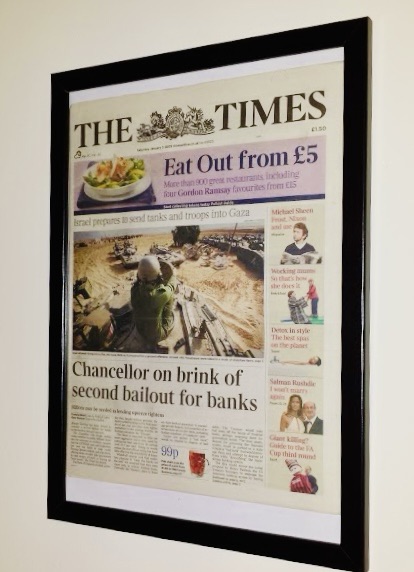
On this day in 2009, Satoshi Nakamoto mined the first block of Bitcoin. Buried deep within the coinbase parameter was a hex-encoded string that decoded to a stark headline from The Times:

“Chancellor on brink of second bailout for banks.”

It was a timestamp, but it was also a mission statement. It signaled the shift from opaque centralized finance to a system defined by absolute mathematical transparency.

Yet, nearly two decades later, I still hear people challenge the “vagueness” of blockchain.

My response is always the same: Read the “Bitcoin: A Peer-to-Peer Electronic Cash System whitepaper.

It is only 9 pages long.

It’s not vague; it is a masterclass in transparency. If you read it, you understand that the “vagueness” exists only in the commentary, not the code.

The same logic applies to the current wave of AI skepticism.

I constantly see posts mocking LLMs because a chatbot couldn’t solve a simple math problem or hallucinated a fact. “It’s broken,” they say.

My response? Read the “Attention Is All You Need” whitepaper.

If you understand the architecture, you understand that these models are probabilistic next-token predictors, not deterministic calculators. When you ask a language model to do strict arithmetic, you are essentially asking a creative writer to do your accounting.

It comes down to this:

🔹 Bitcoin is the right tool for trustless, transparent value transfer.

🔹 LLMs are the right tool for pattern matching, summarization, and generation.

The tools aren’t broken. We just have to stop trying to use a screwdriver to hammer in a nail.

Right tool for the right task.

#Bitcoin #GenesisBlock #Blockchain #AI #TechLiteracy #Satoshi

𝐀𝐈 𝐢𝐧 𝟐𝟎𝟐𝟔: 𝐓𝐡𝐞 𝐒𝐡𝐢𝐟𝐭 𝐟𝐫𝐨𝐦 𝐂𝐨𝐧𝐯𝐞𝐫𝐬𝐚𝐭𝐢𝐨𝐧 𝐭𝐨 𝐀𝐜𝐭𝐢𝐨𝐧

We are rapidly hitting the natural ceiling of the “chatbot era.”

For the last three years, the dominant AI strategy has been refining human-to-machine conversation. We’ve built better models and smoother interfaces, essentially trying to make software “talk” like a human. We have automated the retrieval and summarization of information.

But as we look toward 2026, simply making AI talk better won’t generate competitive advantage. To understand the necessary strategic pivot, consider this insight from Paulo Coelho:

“𝘉𝘦 𝘤𝘳𝘦𝘢𝘵𝘪𝘷𝘦. 𝘔𝘦𝘯 𝘰𝘯𝘭𝘺 𝘭𝘦𝘢𝘳𝘯𝘵 𝘩𝘰𝘸 𝘵𝘰 𝘧𝘭𝘺 𝘸𝘩𝘦𝘯 𝘵𝘩𝘦𝘺 𝘴𝘵𝘰𝘱𝘱𝘦𝘥 𝘪𝘮𝘪𝘵𝘢𝘵𝘪𝘯𝘨 𝘣𝘪𝘳𝘥𝘴.”

𝐓𝐡𝐞 “𝐁𝐢𝐫𝐝 𝐈𝐦𝐢𝐭𝐚𝐭𝐢𝐨𝐧” 𝐓𝐫𝐚𝐩

For centuries, humans failed to fly because we were obsessed with flapping wings. We thought flight meant mimicking nature. We only succeeded when we stopped imitating birds and built fixed wings and engines—mechanisms that looked different but achieved the outcome of flight far more effectively.

Right now, many enterprises are still flapping their wings.

We are forcing complex business processes into chat interfaces. While useful for triage, the chat box is a bottleneck for true cognitive work. It mimics human interaction, rather than leveraging machine speed and scale.

𝟐𝟎𝟐𝟔: 𝐓𝐡𝐞 𝐄𝐫𝐚 𝐨𝐟 𝐭𝐡𝐞 𝐀𝐠𝐞𝐧𝐭

If the current phase is imitation, 2026 is about flight. The strategic advantage will shift from Conversational Bots to Autonomous AI Agents.

The difference is the move from imitation to agency:

🔹 𝐓𝐡𝐞 𝟐𝟎𝟐𝟒 𝐂𝐡𝐚𝐭𝐛𝐨𝐭 tells you the steps required to fix a supply chain disruption. It chats with you about the problem.

🔹 𝐓𝐡𝐞 𝟐𝟎𝟐𝟔 𝐀𝐠𝐞𝐧𝐭 detects the delay, re-routes the shipment, updates the ERP, and simply asks for your final sign-off.

The future isn’t a better chat interface; it is cognitive orchestration.

𝐓𝐡𝐞 𝐒𝐭𝐫𝐚𝐭𝐞𝐠𝐢𝐜 𝐌𝐚𝐧𝐝𝐚𝐭𝐞

To prepare for 2026, stop asking, “How can we add a chat interface to this workflow?”

Start asking, “If we stop imitating human conversation, what outcomes can we empower an agent to execute autonomously?”

Don’t just build a better bird. Build the engine.

AIstrategy #AIAgents #2026 #FutureOfWork #EnterpriseAI

One Book At A Time – 2025

2025 has been a year of AI explosion, and honestly, it is a lot to keep up with. Every week brings a wave of new research papers, industry newsletters, blog posts, benchmark reports, and endless social media feeds.

With so much noise, finding time for long-form reading, both AI and non-AI books, has become a challenge. To stay ahead, I’ve developed a new routine: every Saturday, I upload my “must-read” papers and newsletters to Google NotebookLM. I generate an Audio Overview and consume it as a podcast during my Sunday morning jog. It’s the perfect way to complete my “reading” while staying active!

Despite the busy year, I managed to finish 7 books. While many are talking about Nexus by Yuval Noah Harari as the standout, my personal favorite was The Mysterious Mr. Nakamoto by Benjamin Wallace – a fascinating 15-year quest to unmask the genius behind crypto.

Here is my full 2025 reading list:

  • The Mysterious Mr. Nakamoto by Benjamin Wallace – It is now clear to me who Mr. Nakamoto is…
  • Nexus by Yuval Noah Harari – A compelling read that serves as excellent evidence that long-form reading remains vital.
  • The Singularity Is Nearer by Ray Kurzweil – For those working in the IT / AI industry, this is a must-read.
  • The Sweaty Startup by Nick Huber – This serves as a great companion to the book The E-Myth, which I first read nearly 30 years ago.
  • Make Meaningful Culture by Daniel Szuc & Josephine Wong – In the era of AI, fostering a meaningful team culture has become more vital than ever.
  • The Secret of Secrets by Dan Brown – I have read all of Dan Brown’s books, and this one is quite good as well.
  • Storyboarding Essentials by David Harland Rousseau & Benjamin Reid Phillips – I chose to read this not for filmmaking, but to improve my skills in crafting more effective video prompts.

How are you tackling your reading list this year? Any AI tools helping you stay productive? 

#AI #ReadingList #NotebookLM #Books2025